

New Home Loans are Growing as Owner-Occupiers Lead the Recovery.
There’s more evidence to suggest that housing could well have a strong year as the number of mortgage commitments jumped in December.
New loans grew by 4.4% which was the largest spike we’ve seen since September of 2016, which was back during the peak of the housing boom in Sydney and Melbourne.
However, unlike the most recent boom, this time around we are seeing a different demographic leading the way with new loan applications – first home buyers and owner-occupiers.
During the last big run in property prices on the East Coast, we saw a large portion of that surge come from investors – particularly from overseas. At that stage, money was flowing from China with overseas investors looking for a safe place to park their money. And there are few better places than Australian residential property as we’ve seen for many decades.
This time around, the participants are different but the end result seems to be the same, with prices rising.

At the same time, we are also seeing considerable interest from owner-occupiers, who appear to be using this opportunity to enter the market now that confidence is returning.
The housing finance landscape has changed dramatically since this time last year thanks to two key developments. The first major hurdle that buyers were worried about in early 2019 was the prospect of a Labor victory and the removal of negative gearing tax benefits.
On top of that, APRA has been imposing a serviceability buffer that made lending requirements far tighter and loans more difficult for people to obtain. First-home buyers, in particular, were a segment of the market that was severely restricted thanks to the APRA guidelines.
With the Liberal victory mid-year and APRA dropping their buffer rate, positive buyer sentiment has returned to the market and first-home buyers and owner-occupiers now have both the willingness and ability to access credit and buy property.
That’s been reflected in median house prices, with the last three months showing significant growth – particularly in Sydney and Melbourne.
Anecdotally, it is a surge that is being led by owner-occupiers who might have missed out on the first boom and are not wanting the same thing to happen to them again. And clearly, the housing finance figures that we’ve seen in December are evidence of what is taking place.
Property Bounces Back
Some recent analysis from CoreLogic shows exactly what the most recent recovery looks like compared to historical falls.
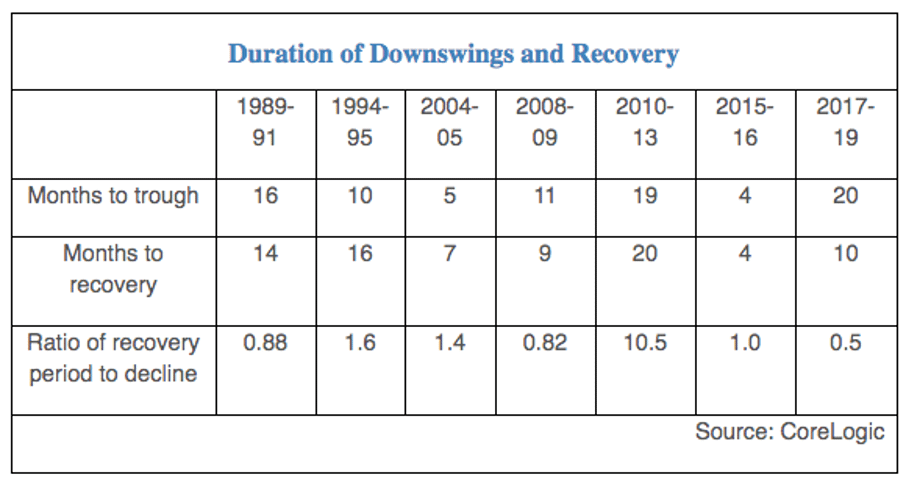
Duration of Downswings (Source: CoreLogic)
Dwelling values across the country have already jumped by 6.7% since June 2019, when national values bottomed out at 8.4% below their peak. This was virtually the same time as the election was taking place and we can see the impact the Liberal victory has had on the recovery.
According to Eliza Owen from CoreLogic, Australia was likely to witness its full nominal recovery by April if the price growth remains at its current pace. This would mean prices had a 10-month recovery period, which is lower than the average recovery time of 11.7 months.
So while the property market did cool off, it is bouncing back – as it always has and always will. That’s why Australian residential property continues to be such a solid investment. The price recovery is also highlighting the importance of buying a property that has owner-occupier appeal.
According to the Australian Bureau of Statistics, 71.4% of home-loan commitments are from owner-occupiers. Their share of the home-loan market jumped sharply compared to the last boom from 2012 to 2017 when their share averaged 59.4%.
Clearly, this stage of the property cycle is seeing owner-occupier homes in good areas be valued highly by the market and these properties will continue to appreciate in value, whether they are free-standing houses, apartments or townhouses. That is one of the cornerstones of our investment strategy and one I strongly urge all property investors to base their strategy around.


